The Orchard and Its Discontents: Austyn Wohlers on Her Debut Novel
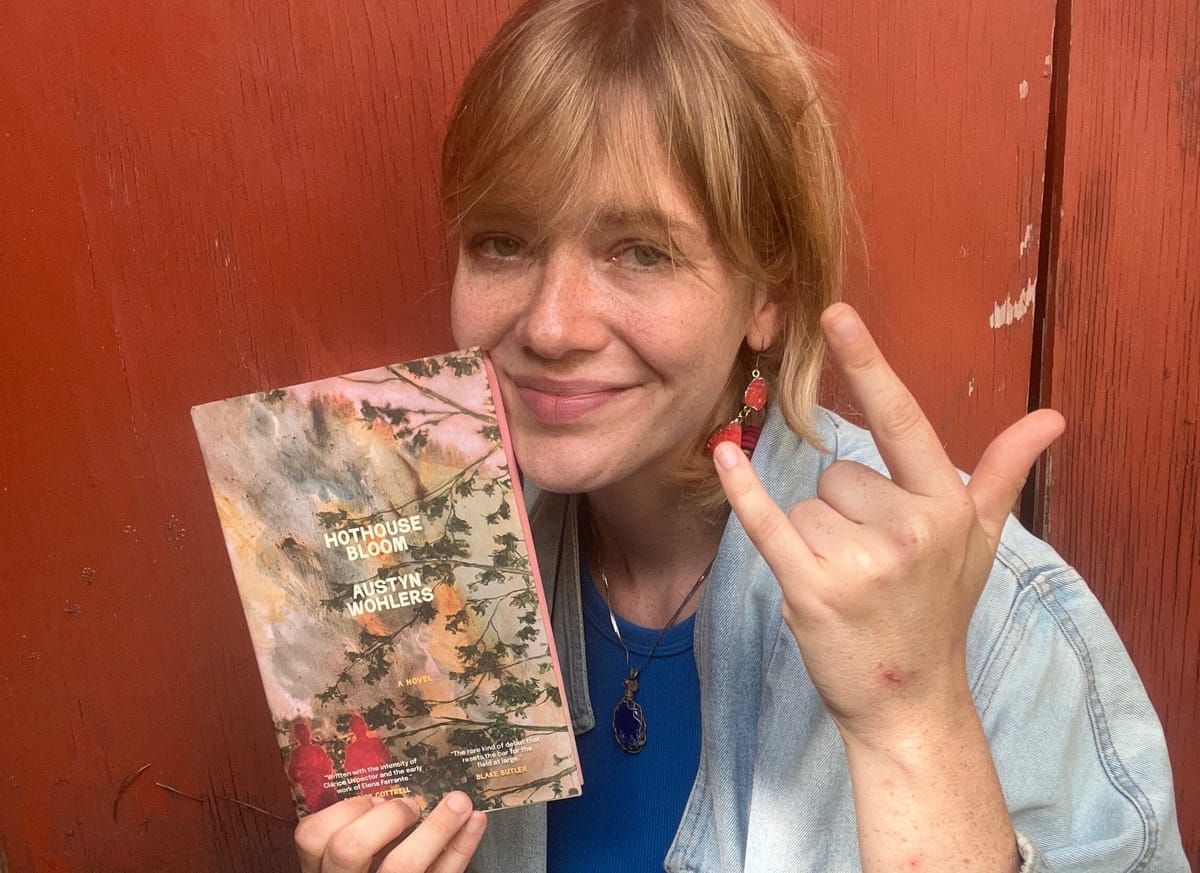
Hothouse Bloom, out yesterday from Hub City, marks the emergence of a talented new novelist in the literary scene—and necessarily, one writing with candor on the pursuit of art itself. Austyn Wohlers’ first book throws the stakes of making into stark relief by imagining what happens to a painter who renounces her career to live out a ruralist’s fantasy on an inherited apple orchard. Having exchanged one harsh reality for another, various psychic dissolutions occur for Wohlers’ ex-artist: external landscapes seep into internal ones, opposing identities coalesce, and spiritual rot encroaches in a book that cross-pollinates what’s gorgeous with the Grotesque.
Needless to say, I was delighted that an advance copy of Hothouse Bloom arrived in my life when it did, and more so to sit down with Wohlers at Brooklyn’s Ange Noir Cafe earlier this month. In addition to talking shop on stylistics and writing routines, we spoke about all that hangs in the balance when it comes to creative success: how one’s art runs parallel to one’s living, how easily its affirmation can be conflated with love, and how Wohlers nails this in Hothouse Bloom specifically.
KATE MEADOWS: First, congratulations on having your first novel out soon! I’d love to hear some version of what brought you to writing and publishing Hothouse Bloom.
AUSTYN WOHLERS: It started as a short story I wrote in an undergraduate fiction workshop. The instructor hated it. He said I didn’t understand “the basics of fiction.” It was devastating. I had a complete breakdown after receiving that feedback. But then I got really spiteful and thought I’m actually going to make this a book and I'm going to make it work. Someone else might have thought, all right, that was my first try at a book, let me try another one. But I was like, “no, I want to stick it to this one guy.”
KATE MEADOWS: A spite novel!
AUSTYN WOHLERS: Several of my professors didn’t gel with this book. One of my MFA said “if you want readers, you're going to have to teach them how to read this novel. If not, fine. You can be James Joyce.” I cried walking to the liquor store after hearing that. But then I was like, who doesn't want to be James Joyce?
KATE MEADOWS: What was the larger timeline, the number of years that you were working on the iteration of Hothouse as a novel?
AUSTYN WOHLERS: I started it right after I turned 22. I think I wrote the first word September 5th, 2018. I did two drafts over six months. Then I put it down for a year and a half, picked it back up during my MFA, changed it a lot, and then worked on it until I was about 25—so I would say I finished it in 2022, then we put it on submission. It got picked up at the end of 2023. And now it's coming out in August 2025.
KATE MEADOWS: How did the concept first materialize for you?
AUSTYN WOHLERS: When writing short stories I tend more towards autofiction, but both this novel and the new one I have drafted are works of imagination. I was interested in that dream of fleeing to the countryside for the “simpler life,” which I think has to do with economic stagnation, lack of class mobility, and stuff like that in our generation. But of course I don't think it's the answer. I was interested in a book that bought into the fantasy and then critiqued it.
KATE MEADOWS: I was compelled by that critique, and how you placed two characters in philosophical opposition. You have Jan, who’s a bohemian, but more of a hedonist than an ascetic. He believes in connection with other human beings, he believes in art—and those are all things that Anna has left behind for the “simpler life.” We waver into his perspective towards the end of the book, so you get more of a sense that Anna could be an unreliable narrator.
AUSTYN WOHLERS: You know, the real tragedy for Anna is that she’s fleeing this world of competition and display where she has to sell herself and judge her self-worth on some sort of scale. But in the end, she can't actually escape from it in the orchard: it’s inherent to all systems that we live in. I was really motivated by a fear of failure. It's interesting, my second book, too, has an ex-artist as the main character. Someone who’s sort of given up.
KATE MEADOWS: I also read your short story in The Baffler, “The Insensible Bond is Your Vision.” There are moments in it where the narrator thinks of art as being for “commiseration.”
AUSTYN WOHLERS: Yes, and specifically tragedy. I'm definitely interested in the tragic form. Hothouse originally ended with Anna dying and with Jan finding her body, which is when the perspective shifted: Things Fall Apart by Chinua Achebe is like that. I'm really inspired by a lot of German literature, like Herman Hesse, where you have the two philosophical foils in dialogue. One book of his I'm thinking about is The Glass Bead Game, which also has a character death and then a perspective-swap. I cut the death, but I still wanted to have that externalization from Anna’s world, at which point you realize that she's actually quite mentally ill.
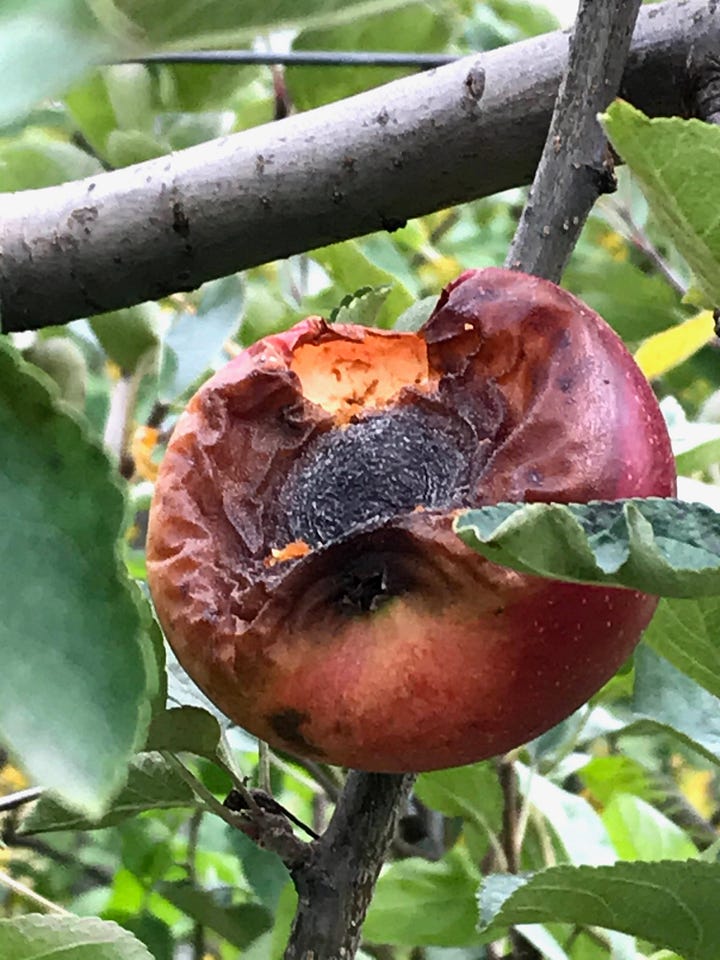
KATE MEADOWS: For a lot of Hothouse Bloom, we’re deep in Anna’s head. There was an interesting shift from Anna feeling rather whimsical or perhaps delusional, trying to spiritually communicate and become “one” with the orchard—you get more of those heady, language-based passages. But later she goes into business mode, after realizing she can’t live on her own and that's why she has to invite other people in.
AUSTYN WOHLERS: Yes, and the “business mode” becomes a way of trying to retain that fantasy, which was ultimately a false thing, right?
KATE MEADOWS: That’s why the ending at McDonalds is fantastic. You know, the idea that we can escape the world that we live in and modern ills by going back to our roots and becoming one with the land—then coming back around and just ordering the cheeseburger. Anna bites in, and the last line of the book is “it tasted great.”
AUSTYN WOHLERS: I'm happy with the last line. I wanted the language of the book to mirror the reality that it's presenting, so it starts off very lush—in Anna’s head—and full of metaphor. Then it ends with plain, simple language—a sentence that would be unfathomable at the beginning of the book. It’s this total drainage of the fantasy.
KATE MEADOWS: Some kind of spell is broken. I thought that was really well done. Speaking of style, the writing did remind me often of Clarice Lispector’s Agua Viva. You incorporated a handful of unconventional flourishes: ellipses, jagged paragraph breaks, a paragraph or two of fragments attached by colons. Then a lot of extended paragraphs of simile after simile which almost creates this system of relation where one thing is never really itself, but it just gets connected to something else, which I thought was quite appropriate for Anna's mindset, too.
AUSTYN WOHLERS: Yes—someone once described it as fractal.
KATE MEADOWS: That’s the perfect word. I was curious about whether those stylistic idiosyncrasies are instinctual for you, or more considered—and if you’ll carry them with you for future work.
AUSTYN WOHLERS: Quite considered, I'd say. I was reading so much Clarice Lispector at the time. I've read everything she's ever put out that's been translated: she completely changed the way that I thought about literature with her way of putting language first. The main interest of the book for me really is the language. I think also part of it—and part of writing about film in the Baffler story—is that I'm a very visual person, but I don't have any visual forms. So, I end up trying to write in a way that feels somehow visual.
I don't know that I will write something so lush and deranged again as Hothouse Bloom—the next novel I have is a lot plottier. It starts off like an erotic thriller. It's fragmented, and narrated in the first person. It's about an alcoholic ex-sculptor who is seduced into working on a Christofascist land art project that is secretly a prison complex. In the beginning, it’s banal: it's just people meeting on a dating app, getting obsessed with each other, and then it ends up this paranoid DeLillo thing.
KATE MEADOWS: I like that you're writing characters that are ex-artists: you know, against the Künstlerroman tradition.
AUSTYN WOHLERS: Like a failed Künstlerroman. They both center characters who have lost faith in art.
KATE MEADOWS: Do you feel like you've observed people in your life go through that, mid-art-life crises?
AUSTYN WOHLERS: Definitely. When I got the novel picked up, I got depressed because I identified so heavily with someone trying to get a novel out. It was my only goal for my whole twenties, and it made everything so simple. Everything in my life revolved around trying to get a book out. I didn't really identify as much with being a novelist.
KATE MEADOWS: What did that feel like, identifying with “struggling artist”?
AUSTYN WOHLERS: It gave me a lot of anxiety. I was one of those people who would look up my favorite writers and think, oh no, they published their first book when they were 29! You know, tons of great writers publish their first book in their 30s, 40s, whatever. But it used to drive me crazy, and I think for me it was really tied in with my idea of my own value and wanting to be loved: thinking “I need to be loved, so I better shut myself up in my room and write this novel instead of connecting with people.” I think it's like that for a lot of people which goes back to the productivity brain that we all are cursed with. But that drive also made things really simple, because I just had one goal. And when I accomplished it, I had to ask myself: what am I doing now?
KATE MEADOWS: What did the process of getting a book published look like for you?
AUSTYN WOHLERS: After completing my MFA, I moved back to Baltimore. I shared with a friend that I was nervous about no longer having any writer friends. Then he introduced me to Ashley Bryant Phillips, who told me I should send my book to the person who ended up becoming my agent. I just got really lucky. I thought it was going to be really hard. During your MFA, you wonder how anyone gets a book published. It used to drive me crazy. They don't really tell you, unless it’s oh, you know, my sister's boyfriend is an editor and he was in a good mood that day.
Someone told me something that stuck with me: which was that you have to make your own luck. You know, stay in the world, and eventually you will meet your sister's boyfriend's editor who's having a good day or whatever. Getting published often doesn't have anything to do with whether or not a book is good—some of it's talent for sure, but also money to apply to MFA programs, access to people who are going to write recommendation letters for your programs. It all really compounds. It’s luck and it’s Zeitgeist too. One thing that I actually learned in my MFA that I think is cool was that you don't necessarily want to get a giant book deal for your first book. Like my friend Blake Butler in Baltimore, who wrote Molly, which just popped off: but his first book was a novella through Calamari Archive. I do believe in building a smaller cult and the slow growth sort of thing.
KATE MEADOWS: Yeah, even with the second or third book—the one that's going to be the hot-hot one—it could take years before people catch on. Sometimes it really is Zeitgeist.
AUSTYN WOHLERS: Right place, right time. You know, at a certain point—whether you get five or twenty reviews, whether you have two thousand Spotify listeners or two hundred thousand—it's just numbers. It has to be about the actual love and pleasure and self-satisfaction of doing it, because I think if you get to a point where it's all external, there's just always going to be more than you could have and you don't have.
I used to think, “fuck people who are only in this for the money.” Now I think at least that’s more noble than clout—just trying to like make enough money so you can write another one.
KATE MEADOWS: What has surviving financially been like for you as a writer?
AUSTYN WOHLERS: I bartended for a long time. Bartending is a great job for writing because you can write in the morning when you're feeling fresh, and then you go in. You meet people, you talk to a lot of types of people that you wouldn’t normally interact with—it's not just your fellow 20-something arts-people—and you don't have to work full-time because it pays very well. I think, more than anything, trying to minimize working full-time has been important for me.
Now I'm substitute-teaching, which has its own beneficial schedule. I get up at 5am. I usually walk, so it’ll usually be within an hour, and I hate getting on the train. It's nice to walk and think. I'll get out at three or four and maybe do some writing, or save writing for days where I’m not working. With substitute teaching, if you can save enough money here and there, you can be flexible with your schedule—if you're having a couple days where you're feeling really motivated to write, you can shift focus on that. I don't know how people do it with full-time jobs. It’s tough.
KATE MEADOWS: I know, especially when you hear about the old-school literary geniuses who were insurance salesmen their whole lives or whatever...
AUSTYN WOHLERS: Kafka has a line about this: “Time is short, my strength is limited, the office is a horror, the apartment is noisy, and if a pleasant, straightforward life is not possible then one must try to wriggle through by subtle maneuvers.”
KATE MEADOWS: Yeah, which is what I think being a working artist is all about in many ways. It's hard here, too, because I think there's a lot of pressure from the other NYC transplants—who make a lot of money working a corporate job—who maintain a certain standard of living and don’t understand how we manage. I have to remind myself that I have everything I need.
AUSTYN WOHLERS: Exactly. I live in a very cheap house with four roommates. I really love that communal way of living, honestly. I try to never take the train here, which cuts down on costs. I usually walk or ride my bike. Also, packing food whenever I’m gonna be gone for a long time so I’m not buying stuff. Those are my living-in-New-York-for-fairly-cheap hacks.
KATE MEADOWS: How does your music career interact with your writing career?
AUSTYN WOHLERS: I think of them as two different outlets for creativity. With writing being maybe more of a way of reflecting and processing the world—and music as more of a way of experiencing and connecting.
Writing always came first. I always thought of music as something I was just going to do in my 20s until the writing career took off. This was another part of my big crisis when finishing the book: okay, is it time to pack it up? But then I realized I want to keep doing music my whole life...so I'm figuring out what my relation to it is going to be. I always thought I was going to have to choose, and I’ve evaded choosing so far.
KATE MEADOWS: I don’t think you have to choose. Sure, time is limited, and people always are going to want to put you in a box and tie you up with a bow—but if either one is bringing someone any form of joy or lessening the suffering of living in any way, that's great.
AUSTYN WOHLERS: Yeah, and that's a great reason to do art, it’s just a good way to get through life, you know?
KATE MEADOWS: I'm glad that we have it.
AUSTYN WOHLERS: Totally. I don't know what I’d do without it.
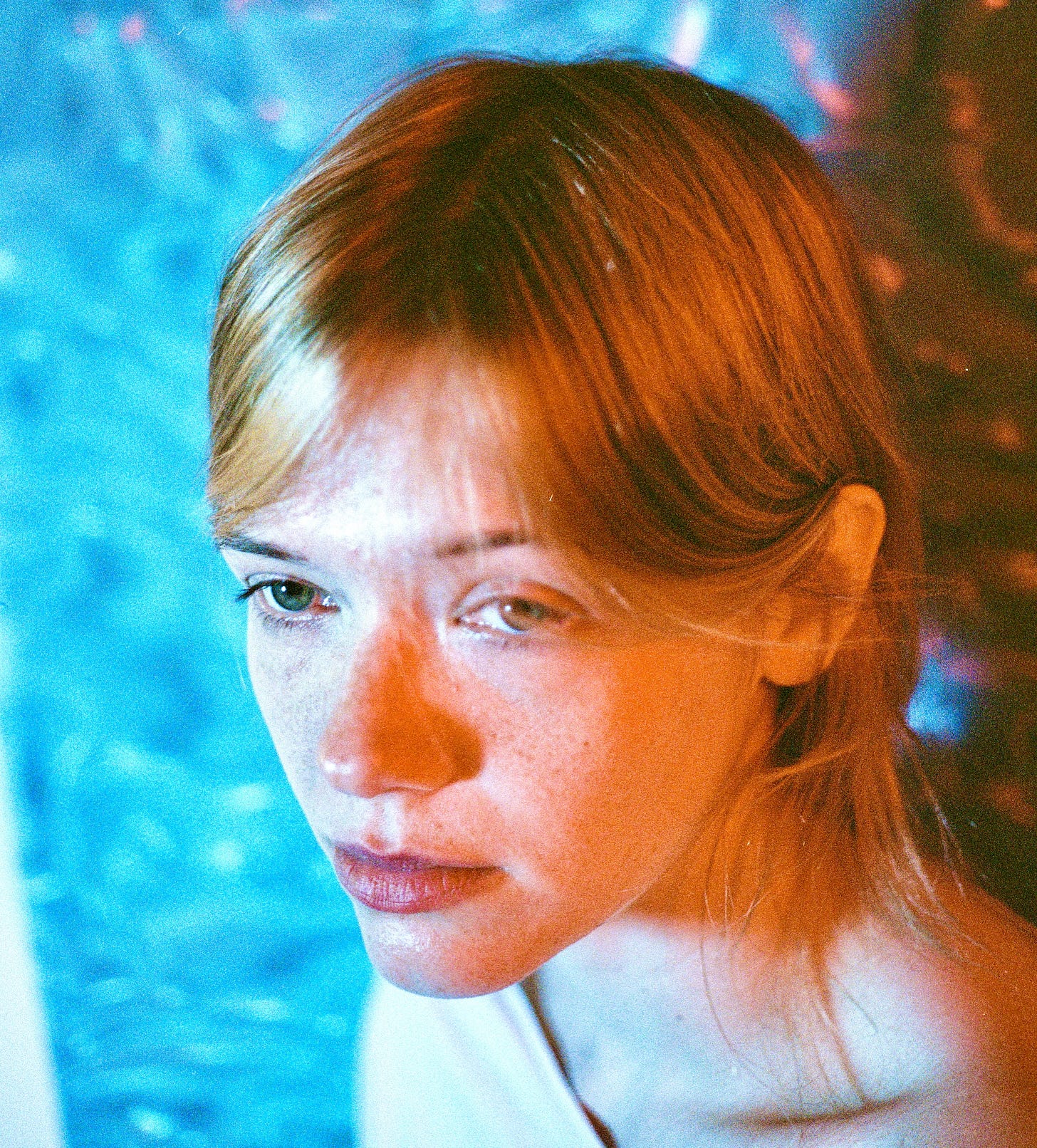
Austyn Wohlers was born in 1996. Her debut novel Hothouse Bloom was called "strikingly original" by Mesha Maren in The New York Times and "the rare kind of review that resets the bar for the field at large" by Blake Butler. Her writing has appeared in The Baffler, The Massachusetts Review, Guernica, and elsewhere. Also a musician, she releases music under her name and with the band Tomato Flower. Order a copy of HOTHOUSE BLOOM | Book Tour Dates